
Unlocking the Hidden Value of Lost Sales Leads for Business Growth

Every business owner, sales manager, or decision maker knows the frustration of losing a sales lead. It feels like a missed opportunity, a potential sale slipping through the cracks. Yet, many businesses treat these lost leads as dead ends, discarding them from their sales pipeline. The truth is, lost sales leads are often not truly lost. They represent valuable opportunities waiting for the right moment to convert.
This post explores why many sales leads are mistakenly considered lost, why timing plays a crucial role in sales success, and how businesses—especially real estate agencies—can unlock the hidden value in historical enquiries. We’ll also introduce practical strategies and tools like the Compound Sales Lead Recovery & Intelligence System™ to help reconnect with these prospects and boost your sales growth.
What Is a Lost Sales Lead?
A lost sales lead is a prospect who once showed interest in your product or service but did not complete a purchase or commitment. Many businesses label these leads as lost when prospects stop responding or delay their decision indefinitely.
In real estate, for example, a potential buyer might enquire about a property but then disappear. The agent might assume the lead is lost and move on. However, this prospect may simply not have been ready to buy at that time.
Why Prospects Stop Responding
Understanding why prospects stop responding helps explain why leads are often misclassified as lost. Common reasons include:
Financial constraints: Buyers may need time to save or arrange financing.
Personal circumstances: Changes in family, job, or health can delay decisions.
Market conditions: Waiting for better property prices or interest rates.
Lack of urgency: The prospect may be casually browsing without immediate intent.
Overwhelmed by options: Too many choices can cause decision paralysis.
For instance, a first-time homebuyer might pause their search after an initial enquiry due to uncertainty about the market or personal finances.
Why "Not Now" Doesn’t Mean "Never"
The phrase “not now” often masks a future opportunity. Prospects who say they are not ready today may become motivated buyers later. Timing is one of the biggest factors affecting sales conversions.
In real estate, a family might delay buying a new home until their current lease ends or until they sell their existing property. This delay doesn’t mean they won’t buy—it means the timing isn’t right yet.
By maintaining contact and nurturing these leads, businesses can be ready when circumstances change.
Common Reasons Leads Don’t Convert Initially
Leads often don’t convert on the first contact for reasons beyond the prospect’s control:
Budget limitations: They may need to adjust their finances.
Lack of information: They might require more details or reassurance.
Competing priorities: Other life events take precedence.
Trust issues: They need time to build confidence in the business.
Wrong product fit: The initial offering might not meet their needs perfectly.
For example, a real estate agency might find a lead interested in a property type that is currently unavailable or outside their price range.
How Changing Circumstances Create New Opportunities
Life changes constantly, and so do customer needs. A lead that was once uninterested or unable to buy may become a prime prospect later due to:
Improved financial situation
Change in family status
Relocation for work
Market shifts making purchases more attractive
New product or service offerings
Consider a couple who initially postponed buying a home due to job uncertainty. Once their employment stabilises, they may return to the market with renewed interest.
Why Businesses Should Never Ignore Historical Enquiries
Historical enquiries are a goldmine of potential sales. Ignoring them means missing out on prospects who have already expressed interest. These leads are warmer than cold prospects because they have some familiarity with your business.
Real estate agencies that revisit past enquiries often find that a significant percentage convert when contacted again at the right time. This approach reduces the cost and effort compared to generating entirely new leads.
How Sales Lead Recovery Helps Identify Prospects Who Are Ready Today
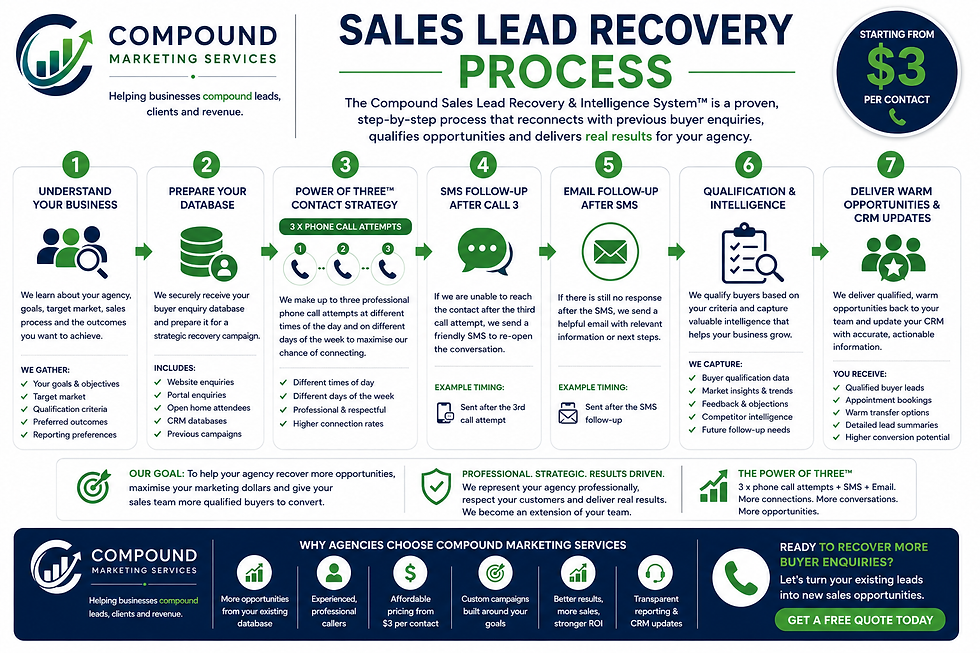
Sales Lead Recovery is a process that involves revisiting and re-engaging past leads to identify those who are now ready to buy. This method includes:
Reviewing CRM data for inactive leads
Contacting leads with personalised messages
Qualifying their current readiness
Updating lead status and notes
This approach helps businesses focus their sales efforts on prospects with the highest likelihood of conversion, improving efficiency and results.
Why Updating CRM Data Improves Future Sales and Marketing
A well-maintained Customer Relationship Management (CRM) system is essential for effective lead recovery. Updating CRM data ensures:
Accurate contact information
Current lead status
Notes on previous interactions
Segmentation for targeted campaigns
For example, a real estate agency that updates its CRM with notes about a lead’s preferred property type and budget can tailor follow-up communications, increasing the chance of conversion.
Introducing the Compound Sales Lead Recovery & Intelligence System™
The Compound Sales Lead Recovery & Intelligence System™ is a professional solution designed to help businesses reconnect with previous enquiries. It combines data analysis, lead scoring, and personalised outreach to recover lost leads efficiently.
Key features include:
Automated identification of leads ready to buy
Integration with existing CRM platforms
Customisable communication templates
Reporting on recovery success rates
For businesses wanting to take it further, Appointment Setting is available as a customised service. This service books qualified prospects directly into your team’s calendar, saving time and ensuring your sales team focuses on closing deals.
The Power of Three™ Sales Lead Recovery Method
While the details of the Power of Three™ Sales Lead Recovery Method are beyond this post, it’s worth noting that this approach uses three strategic touch points to maximise lead recovery success. This method is part of the Compound system’s strength in reconnecting with prospects.
Practical Tips for Recovering Lost Sales Leads
Segment your leads based on last contact date, enquiry type, and lead source.
Personalise your outreach to remind prospects why they contacted you.
Use multiple channels such as email, phone calls, and SMS.
Offer new information or incentives to spark interest.
Track responses and update your CRM promptly.
Be patient and persistent without overwhelming the prospect.
Comparing Recovering Existing Leads and Generating New Leads
Aspect | Recovering Existing Leads | Generating New Leads |
Cost | Lower, as leads are already familiar | Higher, requires marketing spend |
Conversion Rate | Higher, warmer leads | Lower, cold leads need nurturing |
Time to Close | Shorter, prospects have prior interest | Longer, need to build awareness and trust |
Effort | Focused outreach and follow-up | Broad campaigns and lead qualification |
Data Quality | Existing data available | Data needs to be collected and verified |
Recovering lost leads is often more efficient and cost-effective, especially for industries like real estate where buying decisions take time.
Why Choose Compound Marketing Services
Compound Marketing Services specialises in helping businesses unlock the value of lost sales leads. Our expertise includes:
Proven lead recovery systems tailored to your industry
Integration with your existing sales processes
Customised appointment setting to save your team time
Transparent reporting and ongoing support
We understand the challenges businesses face with lead management and provide practical solutions that deliver measurable results.
Frequently Asked Questions
Q: How often should I review lost sales leads?
A: Regularly review your lost leads every 3 to 6 months to catch changes in prospect readiness.
Q: Can lost leads be recovered in all industries?
A: Yes, while examples here focus on real estate, the principles apply across sectors like finance, automotive, and professional services.
Q: What if a lead says they are still not ready?
A: Respect their timing but schedule a follow-up for a future date to stay on their radar.
Q: How does Appointment Setting work?
A: Qualified prospects are contacted and booked directly into your sales team’s calendar, reducing admin and improving conversion chances.
Q: Will recovering lost leads interfere with new lead generation?
A: No, both strategies complement each other and together improve overall sales performance.
Unlocking the hidden value of lost sales leads can transform your sales results. By understanding why leads don’t convert immediately and using smart recovery strategies, your business can reconnect with prospects ready to buy today. The Compound Sales Lead Recovery & Intelligence System™ offers a professional, proven way to do this efficiently.
Take the next step and contact Compound Marketing Services to learn how we can help you recover lost leads and grow your business. Don’t let valuable opportunities slip away—turn your lost leads into loyal customers.



Comments