
How to Recover Old Sales Leads and Book More Appointments in Australia - Sales Lead Recovery

Old sales leads are not dead by default. Many are simply unworked, poorly followed up, contacted at the wrong time, or sitting in a spreadsheet while the buyer is still comparing options.
For Australian businesses, that can mean real revenue is hiding in past enquiry forms, CRM records, expo lists, quote requests, web leads, phone enquiries and cancelled appointments. The opportunity is not to “blast” everyone with the same message. The opportunity is to recover the right leads with a careful, compliant, appointment-focused process.
This guide explains how sales lead recovery works, why aged leads can still convert, which SMS, email and call strategies perform best, and when it makes sense to outsource to specialists such as Compound Marketing Services.

What is sales lead recovery?
Sales lead recovery is the process of reconnecting with people who previously showed interest but never became a booked appointment, customer or client.
These leads may include:
Website enquiries that never received a reply
Quote requests that went cold
Prospects who said “not right now” months ago
The goal is simple. Turn past interest into a current conversation, then guide qualified prospects into appointments.
Good sales lead recovery is not random calling. It starts with data cleaning, intent scoring, message planning, multi-channel follow-up, appointment booking and reporting. The best campaigns protect your brand while giving old prospects an easy reason to re-engage.
Why can old leads still convert?
Old leads can convert because timing changes. A prospect who was not ready six months ago may be ready now. Their budget may have changed. Their supplier may have let them down. Their problem may have become more urgent.
In many Australian markets, people take time to make buying decisions. This is common in industries such as:
Aged leads often fail because the business stops too early. One missed call and one generic email rarely give a prospect enough chance to respond.
Old leads also have one clear advantage over cold prospects. They already know something about the business, product or offer. That prior awareness can make the conversation warmer if the follow-up is respectful and specific.
The best old lead campaigns do not assume every contact is ready to buy. They find out who still has a need, who should be nurtured, and who should be removed from the list.
Which old leads should be recovered first?
Not every old lead deserves the same effort. Start by sorting the list so your team spends time where the chance of booking an appointment is highest.
Which leads show the strongest buying signals?
Prioritise leads that took a meaningful action, such as:
Requested a quote
Asked for a call back
Completed a detailed form
Spoke with a salesperson before
Opened or replied to past emails
Booked an appointment but did not attend
Asked about price, availability or timing
These leads are more valuable than vague contacts with little context.
How old is too old for a sales lead?
There is no single cut-off. A three-month-old lead may be worth calling in a fast-moving category. A two-year-old lead may still be useful in a high-consideration purchase, especially if the original need could return.
As a guide, sort leads into practical age groups:
Lead age | Best approach | Main risk |
0 to 30 days | Fast call, SMS and email follow-up | Losing momentum |
1 to 6 months | Reconnect with context and a simple question | Prospect may have chosen someone else |
6 to 18 months | Requalify need before pitching | Details may be outdated |
18 months or older | Use a softer reactivation message | Contact data may be poor |
The older the lead, the more the message should focus on checking current interest rather than pushing for a sale.
What is the best process to recover old sales leads?
A strong recovery process is structured but human. The aim is to create enough contact attempts to be useful without becoming annoying.
Step 1. Clean the data
Start by removing obvious problems:
Duplicate contacts
Invalid phone numbers
Incomplete names
Clearly irrelevant enquiries
Contacts who opted out
Existing customers who should not receive a prospecting message
Check that your team can lawfully contact the list under Australian privacy and spam rules. For email and SMS, consent and unsubscribe options matter. If in doubt, get advice before sending bulk messages.
Step 2. Segment the list
Group leads by source, age, product interest, location, past outcome and urgency. A person who requested a solar quote needs a different message from someone who downloaded a general guide.
Useful segments include:
Never contacted
Contacted but no answer
Quoted but not closed
Appointment booked but not attended
Asked to be contacted later
Long-term nurture lead
Segmentation improves reply rates because the message feels relevant.
Step 3. Write a simple recovery offer
The offer does not need to be a discount. Often, the best offer is clarity.
Examples include:
A quick eligibility check
A fresh quote based on current needs
A short appointment with a specialist
A limited appointment window for the week
A review of the previous enquiry
An updated recommendation
Keep the offer low-pressure. The goal is to restart the conversation.
Step 4. Use several contact channels
Most people will not respond to one channel. Use SMS, email and phone calls together, with sensible spacing.
A basic sequence might look like this:
Day | Channel | Purpose |
Day 1 | SMS | Reconnect and invite a reply |
Day 1 or 2 | Call | Attempt live conversation |
Day 2 | Provide context and booking option | |
Day 4 | Call | Follow up on the first message |
Day 7 | SMS | Final simple check-in |
Day 14 | Move to nurture or close the loop |
The exact sequence should match the market, lead value and consent status.

How should SMS be used for old lead recovery?
SMS works well because it is short, direct and easy to reply to. It is often the best first touch for aged leads, especially if the person may not remember the original enquiry.
A good recovery SMS should:
Identify the business clearly
Refer to the past enquiry in plain language
Ask a simple question
Give an easy next step
Include opt-out wording where required
Example SMS:
Hi Sam, it’s Alex from [Business]. You asked us about [service] a while back. Are you still looking into this, or has it already been sorted? Reply YES and we can send available appointment times.
For older leads, use a softer version:
Hi Sam, it’s Alex from [Business]. You contacted us some time ago about [service]. Just checking if this is still on your list, or if we should close off the enquiry.
SMS should not do all the selling. Its job is to create a reply or open the door for a call.
What should a recovery email include?
Email gives more room for context, but it must still be concise. Old lead emails fail when they explain too much, sound automated, or ask for a big commitment too soon.
A strong recovery email includes:
A clear subject line
A reminder of the original enquiry
A short reason for contacting now
One call to action
A plain unsubscribe option where required
Example subject lines:
Are you still looking at [service]?
Quick follow-up on your [service] enquiry
Should we keep your enquiry open?
Appointment times available this week
Example email:
Hi Sam, You previously contacted us about [service]. I’m checking whether you are still looking for help with this, or whether it has already been sorted. If it is still relevant, we can book a short appointment to review your options and answer any questions. Would you prefer a weekday morning or afternoon? Thanks, [Name]
Notice the question at the end. Asking someone to choose between two appointment windows is easier than asking them to “get in touch”.
How should phone calls be handled?
Phone calls are where appointments are usually won or lost. The mistake many teams make is treating an old lead like a brand-new enquiry, or launching into a pitch before confirming context.
A useful call structure is:
Confirm the person
Explain the reason for the call
Refer to the old enquiry
Ask if the need still exists
Requalify the basics
Offer the next appointment step
Confirm details by SMS or email
A simple opening:
“Hi Sam, it’s Alex from [Business]. You made an enquiry with us a while ago about [service]. I’m not sure if the timing is still right, but I wanted to check whether you’re still looking into it.”
This opening works because it gives the prospect room to answer honestly. If they say yes, move to qualification. If they say no, ask whether the issue is solved or delayed. If they ask not to be contacted again, record that immediately.
Good call handling is calm, polite and quick. The aim is not to pressure someone. The aim is to find out whether there is still a real problem your business can help solve.

How many follow-up attempts are enough?
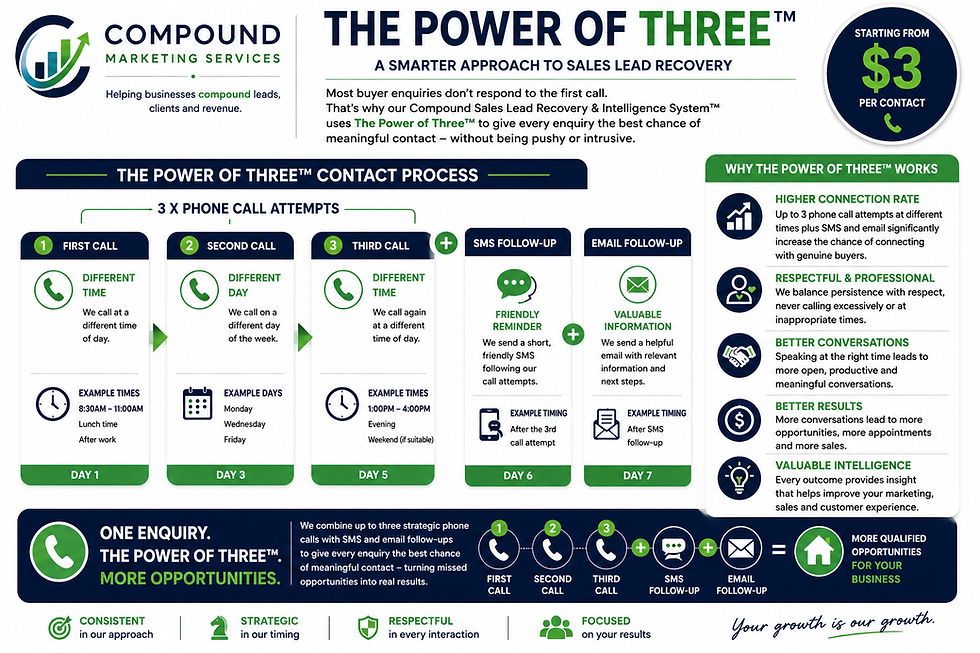
One follow-up attempt is rarely enough, but repeatedly chasing a lead can also damage trust. That is why Compound Marketing Services uses our Power of Three™ approach to sales lead recovery.
The Power of Three™ is based on making three structured contact attempts, using a combination of phone, SMS and email where appropriate. This gives each lead multiple opportunities to respond without overwhelming them with excessive follow-up.
For many businesses, three well-timed attempts can be more effective than a long sequence of repetitive calls. Each attempt should have a clear purpose and, where possible, use a different communication channel.
A typical Power of Three™ sequence may include:
Attempt 1: Phone call with an SMS or email follow-up if there is no answer
Attempt 2: A second contact attempt at a different time or on a different day
Attempt 3: A final follow-up designed to prompt a clear response or next step
Contact should stop sooner if the prospect:
Books an appointment
Says they are not interested
Asks not to be contacted
Has an incorrect number or invalid email
Is clearly not suitable for the offer
Every attempt should also be recorded. Your CRM should show the date, contact method, outcome, notes and next step so that future follow-up is based on accurate information rather than guesswork.
The goal of the Power of Three™ is not to chase leads endlessly. It is to give valuable sales opportunities a fair chance to convert through consistent, professional and measured follow-up.
What appointment booking message works best?
The best appointment booking message is specific. Do not say “let us know if you want to chat”. That puts the work on the prospect.
Use simple options:
“We have times available on Tuesday or Thursday. Which suits better?”
“Would a 10-minute call tomorrow morning work?”
“I can book you for a quick review this week if the issue is still current.”
“Do you want us to reopen the enquiry and arrange a time?”
For higher-value leads, offer a short discovery appointment before a full consultation. This reduces friction and helps qualify the person before your specialist spends time with them.
Always confirm the appointment in writing. Include the date, time, who will call or attend, what the prospect should prepare, and how to reschedule.
What should be measured in a lead recovery campaign?
Track more than sales. Old lead recovery often reveals problems in the original sales process, data quality and response speed.
Measure:
Contact rate
Reply rate
Appointment booking rate
Appointment show rate
Qualified opportunity rate
Sales conversion rate
Opt-out rate
Wrong number or bad data rate
Average time from recovered lead to appointment
These numbers show whether the campaign is healthy. For example, a high reply rate but low booking rate may mean the offer is weak. A strong booking rate but poor show rate may mean confirmations need work.
When should Australian businesses outsource lead recovery?
Outsourcing to an Australian Sales Lead Recovery call centre makes sense when the list is large, old, messy or too valuable to leave untouched.
It can also help when internal teams are already busy handling fresh enquiries. New leads need fast responses, while aged leads need steady, patient follow-up. Trying to do both with the same team often means one group gets neglected.
Consider outsourcing when:
Leads have been sitting untouched for months
The CRM has poor notes or inconsistent status labels
Sales staff avoid old leads because they expect rejection
There are hundreds or thousands of contacts to process
Appointment setting needs to happen quickly
You need calling, SMS and email managed together
You want reporting without adding internal workload
Compound Marketing Services provides sales lead recovery services in Australia for businesses that want to reactivate neglected leads and turn them into qualified appointments. A specialist team can clean the list, build the contact sequence, handle replies, make calls, book appointments and report on outcomes.
The main benefit is focus. A recovery campaign works best when someone owns it every day.

What legal and brand risks should be avoided?
Lead recovery must respect privacy, consent and customer experience. In Australia, businesses should take care with spam rules, unsubscribe handling, privacy obligations and internal do-not-contact records.
Avoid these mistakes:
Sending bulk SMS without proper consent
Hiding the business name
Calling repeatedly after someone opts out
Using misleading urgency
Making claims that cannot be supported
Failing to record contact outcomes
Treating old leads as if they owe you a reply
The brand risk is just as real as the legal risk. A respectful message can revive trust. A pushy message can end it.
How can old leads be turned into booked appointments faster?
Speed improves when the process is clear before contact begins.
Use this checklist:
Clean the list before sending messages
Segment leads by source and intent
Write short SMS and email templates
Prepare a simple call script
Define what counts as a qualified appointment
Offer specific appointment times
Confirm bookings immediately
Track every outcome in the CRM
Remove opt-outs and unsuitable contacts
Review results after the first week
The most common reason old lead campaigns fail is inconsistency. Someone sends one email, makes a few calls, gets busy, then the list goes cold again. Recovery needs rhythm.
Frequently asked questions about old sales lead recovery
Are old sales leads worth contacting?
Yes, many old leads are worth contacting if they originally showed clear interest and can be contacted lawfully. The best results usually come from quote requests, missed call backs, uncontacted web leads and prospects who asked for follow-up later.
What is the best first message for an aged lead?
A short SMS often works best. It should identify the business, mention the previous enquiry and ask whether the need is still current. Keep it easy to answer.
How long should a lead recovery campaign run?
Most campaigns need one to three weeks for the first contact sequence. Larger databases may need staged recovery over several months so replies and appointments can be managed properly.
Should old leads get a discount?
Not always. A discount can help in some markets, but a fresh review, updated quote, eligibility check or priority appointment is often more effective. The offer should match the reason the person enquired in the first place.
Can lead recovery damage a brand?
It can if the follow-up is careless, too frequent or non-compliant. A well-run campaign protects the brand by being clear, polite and easy to opt out of.
What is the key takeaway for Australian businesses?
Old leads represent past demand. Some will no longer be relevant. Some will be unreachable. But a portion may still have the same problem, and they may appreciate a timely, respectful follow-up.
The winning approach is simple: clean the data, segment the list, use SMS, email and calls together, ask clear questions, offer specific appointment times, and record every outcome.
If the list is large or has been neglected for too long, outsourcing to a specialist such as Compound Marketing Services can help turn dormant enquiries into booked appointments without pulling your internal team away from fresh leads.

Comments