
Why Old Sales Leads Can Be Easier to Re-Engage Than Completely New Prospects


Businesses often assume that the best sales opportunity is always the newest one.
Fresh enquiries are exciting. They feel current. They have just clicked an ad, submitted a website form, requested a quote or contacted the business.
But older sales leads can sometimes offer an important advantage:
They already know who you are.
A previous enquiry has already encountered your brand, product or service at least once.
They may have visited your website.
They may have spoken with your team.
They may have requested pricing.
They may have compared your business with competitors.
They may even have seriously considered purchasing before deciding the timing was not right.
That existing familiarity can make Sales Lead Recovery an extremely useful addition to a business's broader sales strategy.
Rather than continually starting every sales conversation from zero, Sales Lead Recovery helps businesses revisit people who have already demonstrated some level of interest.
Previous Sales Leads Have Already Raised Their Hand
There is an important difference between a completely cold prospect and someone who previously made an enquiry.
A cold prospect may have:
Never heard of your business
Never considered your service
No immediate requirement
No prior relationship with your brand
A previous sales lead is different.
At some point, they took an action.
Perhaps they:
Submitted a website form
Requested a quote
Called the business
Responded to an advertisement
Downloaded information
Asked for pricing
Requested a consultation
Attended an open home
Enquired about finance
Asked about a product
Spoke with a salesperson
That means there was already a reason for the enquiry.
The important question becomes:
Does that reason still exist today?
Not Every Lost Lead Was Actually a Bad Lead
A prospect can fail to convert for many reasons.
The quality of the lead is only one possibility.
A person may have been genuinely interested but:
The timing was wrong
Their budget changed
They became busy
They delayed the project
Another priority came first
They were waiting for approval
Their circumstances changed
They stopped responding
The salesperson did not follow up sufficiently
They selected another supplier temporarily
They simply decided to wait
This is why businesses should be careful about assuming that every unconverted enquiry was worthless.
Sometimes the problem wasn't the customer.
Sometimes it wasn't the product.
Sometimes it wasn't even the sales process.
Sometimes it was simply timing.
Our article on reviving cold sales leads explores why apparently inactive prospects can still contain genuine opportunities.
Familiarity Can Make the Conversation Easier
A previous prospect may already recognise:
Your business name
Your product
Your service
Your website
Your industry
The reason they originally enquired
That can reduce the amount of introductory education required compared with contacting a completely new cold prospect.
Instead of beginning with:
“Have you ever considered this service?”
the conversation may begin with:
“You previously enquired with us about this service. I just wanted to see whether it is something you are still considering.”
That is a very different starting point.
The prospect has already demonstrated relevance.
The purpose of the recovery conversation is to determine whether the opportunity has become active again.
Old Leads May Be Further Along in the Buying Process
A completely new prospect may still be at the beginning of their research.
They might need to:
Understand the problem
Research possible solutions
Compare providers
Learn about pricing
Speak with family or colleagues
Determine their budget
Decide whether they actually want to proceed
A historical lead may have already completed several of those steps.
They may already understand the service.
They may have previously received a quote.
They may have compared providers.
They may know roughly what the purchase involves.
The missing ingredient may simply have been readiness.
This is one reason old sales leads can sometimes become productive conversations relatively quickly once the customer's circumstances change.
Previous Quote Requests Can Be Particularly Valuable
Quote requests are an excellent example.
Someone who requested a quote usually had more than casual curiosity.
They were considering a purchase seriously enough to ask:
How much will this cost?
Yet many quotes never become sales.
The customer may:
Put the project on hold
Decide the timing is wrong
Wait for more money
Choose another supplier
Fail to make a decision
Stop responding
Months later, the project may become active again.
That is why historical quote requests can be valuable candidates for recovery.
Read more about recovering unfinished quotes.
Website Enquiries Have Already Chosen to Contact You
Website leads can also be especially valuable.
A website enquiry means the prospect found your business and deliberately chose to make contact.
That person may have discovered you through:
Google search
SEO
Google Ads
Social media
Referral
Another website
Direct search
Previous brand awareness
They then took the additional step of filling out a form or contacting the business.
If that lead was never properly worked, the marketing effort that produced it may not have been fully utilised.
Our guide to recovering cold website leads explains how previous web enquiries can be systematically revisited.
Google Ads Leads Have Already Cost Money to Acquire
Businesses can spend substantial amounts generating enquiries through Google Ads.
Once the prospect clicks the advertisement, part of the marketing budget has already been spent.
If the prospect submits an enquiry and does not convert, generating another completely new lead requires additional advertising spend.
This is where Sales Lead Recovery can provide another option.
Rather than immediately replacing every unsuccessful paid lead, businesses can periodically revisit those previous enquiries to determine whether circumstances have changed.
Learn more about maximising Google Ads leads through Sales Lead Recovery.
The Customer May Simply Be Ready Now
Consider several common examples.
Solar
A homeowner enquired about solar 12 months ago but decided not to proceed because of budget constraints.
A year later:
Their electricity bills may be higher
Their income may have changed
Battery technology may be more appealing
Their financial position may have improved
The reason they originally enquired may still exist.
Real Estate
A homeowner requested an appraisal but decided not to sell.
Twelve months later:
Their family circumstances may have changed
They may be relocating
Their financial position may have changed
They may now be actively considering selling
The earlier appraisal enquiry becomes relevant again.
Finance
A customer asked about refinancing but couldn't proceed.
Months later:
Their income may have increased
Their employment may have changed
Their property value may be different
Their financial position may have improved
The original finance enquiry may now be worth revisiting.
Home Improvements
A homeowner requested a renovation quote but delayed the project.
Later:
They may have saved more money
Obtained finance
Finished another project
Decided the improvement is now a priority
The opportunity was postponed rather than permanently lost.
Strong Follow-Up Can Make a Big Difference
Not every lead that appears cold received strong follow-up in the first place.
A salesperson may have:
Called once
Left one voicemail
Sent one email
Tried at the wrong time
Become busy with newer leads
Forgotten to schedule another attempt
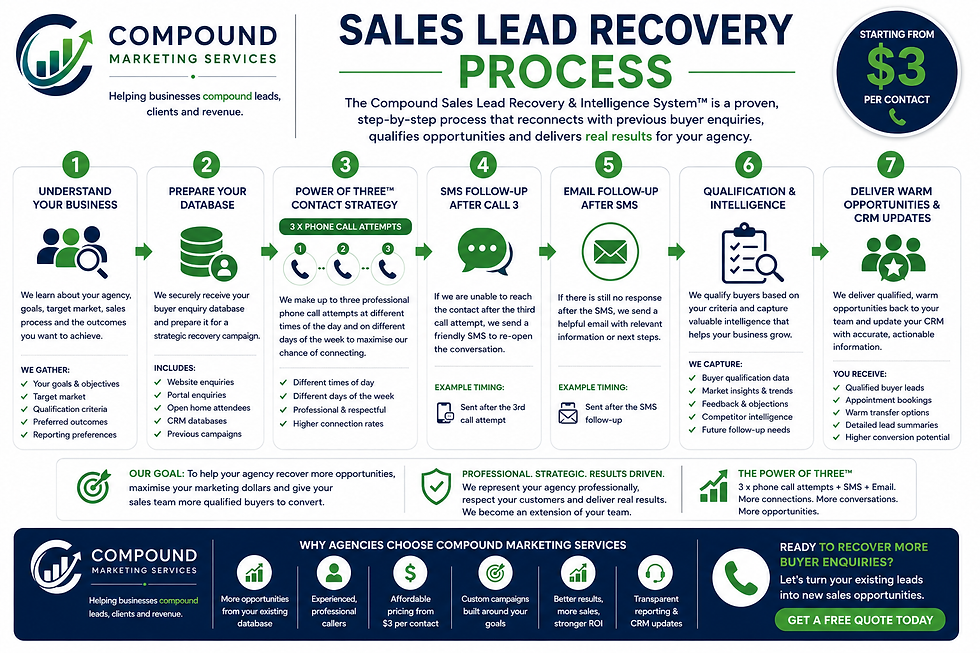
That is why Compound Marketing Services uses the Power of Three™ as part of our standard Sales Lead Recovery approach.
Eligible contacts can receive up to three professional contact attempts made on different days and at different times, supported by SMS and email where appropriate.
Learn more about the Power of Three™ Sales Lead Recovery Method.
One unsuccessful telephone call should not automatically determine the future value of an enquiry.
Sales Lead Recovery Can Reduce Dependence on Constant Acquisition
Fresh lead generation remains important.
Businesses need new customers entering the sales pipeline.
Compound Marketing Services also provides Pay Per Lead Sales Lead Generation for businesses looking to generate new qualified opportunities.
But relying exclusively on fresh acquisition can become expensive.
If every unconverted prospect is immediately replaced with another paid lead, the business may continually spend money without fully maximising previous marketing investment.
A balanced strategy can include:
Fresh Lead Generation
to continuously create new opportunities.
And:
Sales Lead Recovery
to revisit previous opportunities that may have become relevant again.
These approaches are complementary rather than competing.
Lead Recovery Can Improve Sales Efficiency
A recovery campaign can also help businesses focus their internal sales team on more useful conversations.
Instead of asking salespeople to manually search through thousands of old CRM records, a structured recovery campaign can identify:
Prospects who remain interested
Prospects who may be ready later
Customers who have already purchased elsewhere
Incorrect contact information
People who no longer need the service
Leads suitable for immediate sales follow-up
The internal team can then focus more of its time on prospects where a current opportunity has been identified.
Your CRM May Contain Years of Forgotten Opportunities
Established businesses can accumulate enormous databases.
A CRM may contain:
Old website leads
Previous quote requests
Google Ads enquiries
Facebook leads
Referral enquiries
Previous customers
Uncontacted leads
Partially contacted leads
Lost opportunities
Old marketing campaign records
Some businesses continually add new contacts without systematically revisiting older ones.
Over time, thousands of potential conversations can disappear beneath newer CRM activity.
Our guide to CRM database recovery explores how businesses can uncover opportunities from these older databases.
Recovering Leads Can Also Produce Useful Intelligence
Even when an old prospect does not become an immediate opportunity, the conversation can provide useful information.
Businesses may learn:
Why customers originally did not proceed
Whether pricing was an issue
Whether competitors were selected
Whether demand still exists
Which products remain interesting
Which regions generate stronger responses
What customers are considering in the future
This can improve both sales and marketing strategy.
Sales Lead Recovery is therefore not only about asking:
“Can we sell to this person today?”
It can also help answer:
“What can this database teach us about our market?”
What Types of Businesses Can Recover Old Sales Leads?
Sales Lead Recovery can potentially benefit many industries where customers enquire before making a final decision.
Examples include:
Solar
Real estate
Finance
Mortgage broking
Insurance
Home improvement
Construction
Trades
Legal services
Education
Recruitment
Automotive
Healthcare
Business services
Professional services
The most important factor is that the business has legitimate historical enquiry data that can appropriately be used for re-engagement.
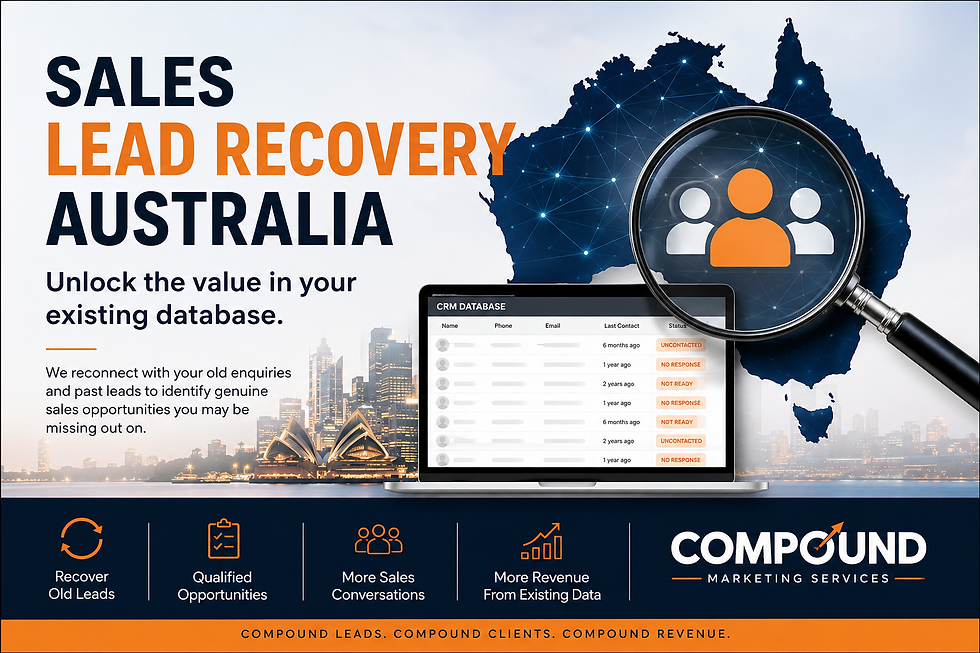
Sales Lead Recovery Can Be Conducted Across Australia
A business does not need to operate from one particular city to benefit from lead recovery.
Campaigns can be conducted remotely across Australia using telephone, SMS and email follow-up.
Businesses can target:
Australia-wide databases
Specific states
Particular service areas
Selected regions
Different geographic customer groups
Read our guide to Sales Lead Recovery Australia to learn more about national campaigns.
How Much Does Sales Lead Recovery Cost?
Compound Marketing Services provides standard Sales Lead Recovery from:
$3 per contact
For example:
1,000 contacts = $3,000
5,000 contacts = $15,000
10,000 contacts = $30,000
Customised campaign requirements, additional qualification or appointment setting may involve additional charges.
The objective is to help businesses identify what value remains inside the database they already paid to create.
Don't Assume an Old Lead Is a Dead Lead
Fresh prospects will always be important.
But older enquiries should not automatically be treated as worthless simply because they did not convert the first time.
They already showed interest.
They already encountered your brand.
They may already understand your product or service.
And most importantly:
Their circumstances may have changed.
A previous “not now” can become today's genuine sales opportunity.
Compound Marketing Services helps businesses professionally reconnect with previous enquiries through our Sales Lead Recovery service, using structured outreach and our Power of Three™ approach to identify opportunities that may otherwise remain hidden inside a CRM.
Contact Compound Marketing Services today to discuss recovering old, dormant and unconverted sales leads already sitting inside your database.
Comments