
How to Determine What Size Solar System a Customer Is Considering | Compound Marketing Services

Understanding Customer Needs: How to Determine the Right Size Solar System for Your Business
In the solar industry, one of the most crucial questions you can ask a potential customer is: What size solar system are you considering? This simple query opens the door to understanding their energy needs, budget, and future plans. It also helps qualify leads effectively, ensuring your sales team focuses on the right prospects and offers tailored solutions.
For solar business owners, directors, sales managers, and consultants, mastering this question can improve sales success and customer satisfaction. This post explores why system size matters, what influences customer preferences, and how regularly updating these details benefits your business. We’ll also introduce the Compound Sales Lead Recovery & Intelligence System™ as a professional tool to reconnect with past enquiries and keep your CRM data fresh.

Why Asking About Solar System Size Is a Key Qualification Question
Asking about the system size early in the sales process helps you understand the customer’s expectations and energy goals. It acts as a filter to identify serious buyers and tailor your recommendations.
Clarifies energy needs: Customers often have a rough idea of how much power they want to generate. This helps you match system options to their consumption.
Reveals budget range: System size correlates with cost. Knowing the size helps you gauge if the customer’s budget aligns with their expectations.
Sets realistic expectations: Some customers may want a system too small or too large for their needs. Early discussion prevents mismatched proposals.
Improves lead qualification: You can prioritise leads based on their readiness and fit, saving time and resources.
By making this question a standard part of your sales conversations, you build a foundation for a more efficient and customer-focused process.
Common Reasons Customers Change Their Preferred System Size
Customer preferences for system size often evolve. Understanding why helps you stay responsive and maintain engagement.
Changes in energy consumption: New appliances, home renovations, or business expansion can increase or decrease power needs.
Budget adjustments: Customers may revise their budget after initial quotes or financing discussions.
Interest in battery storage or EV chargers: Adding these components often requires larger systems.
Future-proofing: Some customers want to install a bigger system now to cover future energy needs or potential price rises.
Government incentives: Changes in rebates or feed-in tariffs can influence system size decisions.
Regularly revisiting system size preferences ensures your proposals stay relevant and competitive.
Household and Business Energy Consumption Patterns
Understanding energy consumption is essential to recommend the right system size.
Household Energy Use
Average Australian household: Uses about 18–20 kWh per day, but this varies widely.
Factors affecting consumption: Number of occupants, appliance types, heating/cooling needs, and lifestyle habits.
Example: A family of four with electric heating and an EV charger will need a larger system than a single occupant in a small apartment.
Business Energy Use
Varies by industry: Retail shops, offices, and manufacturing facilities have different load profiles.
Operating hours: Businesses running 24/7 require larger systems or hybrid solutions.
Peak demand: Some businesses have high peak loads that influence system design.
Collecting detailed energy usage data helps you recommend systems that meet daily and peak demands efficiently.
Budget and Finance Considerations
Budget is a major factor in system size decisions. Customers balance upfront costs with long-term savings.
Upfront cost: Larger systems cost more but deliver greater energy generation.
Financing options: Loans, leases, and power purchase agreements can affect affordability.
Return on investment: Customers want to know payback periods and savings on electricity bills.
Incentives: Government rebates and feed-in tariffs can reduce costs and influence system size.
Discussing budget openly helps you propose solutions that fit financial constraints while maximising value.
Battery Storage and EV Charger Integration
Adding battery storage or electric vehicle (EV) chargers changes system requirements.
Battery storage: Requires additional solar capacity to charge batteries and supply home loads during outages or peak times.
EV chargers: Increase daily electricity consumption, especially with fast chargers.
System sizing: Customers integrating these technologies often need 30–50% larger systems.
Explaining these impacts helps customers plan for future upgrades and avoid undersized systems.
Future Energy Needs and Planning
Customers’ energy needs rarely stay static. Planning for the future is essential.
Home expansions: Adding rooms or new appliances increases demand.
Business growth: New equipment or extended hours raise consumption.
Technology adoption: Smart homes, EVs, and battery storage require more power.
Energy price trends: Rising electricity costs encourage larger systems to maximise savings.
Encourage customers to think ahead so their solar system remains effective for years.
Why Regularly Updating System Requirements Improves CRM Data
Keeping customer data current is vital for effective sales and marketing.
Reflects changing needs: Updated info lets you tailor follow-ups and offers.
Improves lead scoring: Accurate data helps prioritise high-potential leads.
Supports personalised communication: Relevant messages increase engagement.
Enables timely re-engagement: You can reconnect when customers’ circumstances change.
Regular updates prevent lost opportunities and strengthen customer relationships.
The Importance of Lead Qualification and Customer Follow-Up
Lead qualification ensures your sales team focuses on prospects ready to buy.
Saves time: Avoid chasing unqualified leads.
Increases conversion rates: Focus on customers with clear needs and budgets.
Builds trust: Demonstrates professionalism and understanding.
Supports pipeline management: Keeps sales forecasts accurate.
Follow-up is equally important to nurture leads and respond to evolving requirements.
How Sales Lead Recovery Identifies Customers Whose Requirements Have Changed
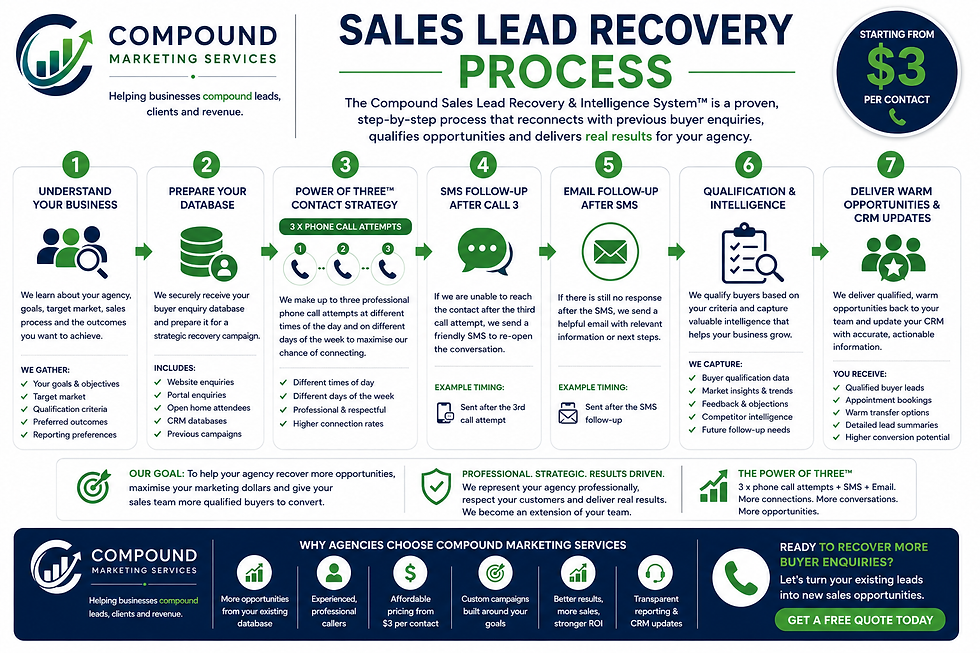
Many potential customers delay decisions or change their minds. Sales Lead Recovery helps you reconnect and update their needs.
Automated outreach: Email, SMS, or calls to past enquiries.
Data refresh: Collect updated info on system size, budget, and timing.
Lead requalification: Identify customers now ready to proceed.
Sales handover: Pass qualified leads to consultants for personalised follow-up.
This process recovers lost opportunities and keeps your sales funnel active.
Introducing the Compound Sales Lead Recovery & Intelligence System™
Compound Marketing Services offers a professional solution to manage lead recovery and intelligence gathering.
Automated system: Streamlines reconnecting with previous solar enquiries.
Data-driven: Captures updated customer requirements and preferences.
Integrates with CRM: Keeps your database accurate and actionable.
Supports the Power of Three™ Sales Lead Recovery Method: A proven approach to maximise lead conversion.
Customised Appointment Setting: For an additional fee, qualified customers can be booked directly into your solar consultants’ calendars, saving time and improving efficiency.
Using this system helps solar businesses maintain strong customer relationships and increase sales.
Practical Examples
Example 1: A family initially interested in a 5 kW system later adds an EV. After follow-up, you recommend upgrading to 7 kW with battery storage to meet new needs.
Example 2: A small business owner’s energy use doubles after expanding operations. Lead Recovery contacts them, updates their requirements, and schedules a consultation for a larger system.
Example 3: A customer’s budget increases after securing financing. Your CRM update triggers a sales call offering a premium system with faster payback.
These examples show how asking about system size and updating data leads to better sales outcomes.
Frequently Asked Questions
Why is system size so important in solar sales?
System size determines energy output, cost, and suitability. Knowing it early helps tailor proposals and qualify leads.
How often should I update customer system requirements?
At least every 6–12 months or whenever you re-engage with the customer.
Can customers change their system size after installation?
Yes, but it’s easier and more cost-effective to plan correctly upfront.
What if a customer doesn’t know what size system they need?
Use their energy bills, household/business info, and future plans to estimate and guide them.
How does Compound’s Lead Recovery system improve sales?
It automates reconnecting with past leads, updates their needs, and helps convert more enquiries into sales.
Why Choose Compound Marketing Services
Expertise in solar marketing: Tailored solutions for the solar industry.
Proven lead recovery methods: Increase conversion rates with minimal effort.
Data-driven approach: Keep your CRM accurate and actionable.
Customisable services: Appointment setting and lead management to fit your business.
Support for Australian solar businesses: Local knowledge and compliance.
Partnering with Compound Marketing Services helps you stay ahead in a competitive market.
Solar system size is more than a number. It reflects your customer’s lifestyle, business needs, budget, and future plans. Asking the right questions and keeping this information current transforms your sales process and builds lasting customer relationships.
Ready to improve your lead qualification and sales follow-up? Contact Compound Marketing Services today to learn how the Compound Sales Lead Recovery & Intelligence System™ can help you reconnect with past enquiries and grow your solar business.
Contact us now to start recovering lost leads and closing more solar sales!



Comments