
Can Sales Lead Recovery Be Done Australia Wide for Multi Location Businesses

Old leads are often treated like dead ends, but many are simply unfinished conversations. A customer who did not book last year might be ready now. A quote request that went cold in Brisbane may still be valuable. A missed enquiry from Perth may only need a timely call, SMS or email to come back into play.
For multi-location businesses, this matters. Across Australia, sales enquiries can sit in different CRMs, spreadsheets, inboxes, call logs and franchise systems. Some leads never received a follow-up. Some were contacted once and forgotten. Some were not ready at the time, then moved on because nobody checked back in.
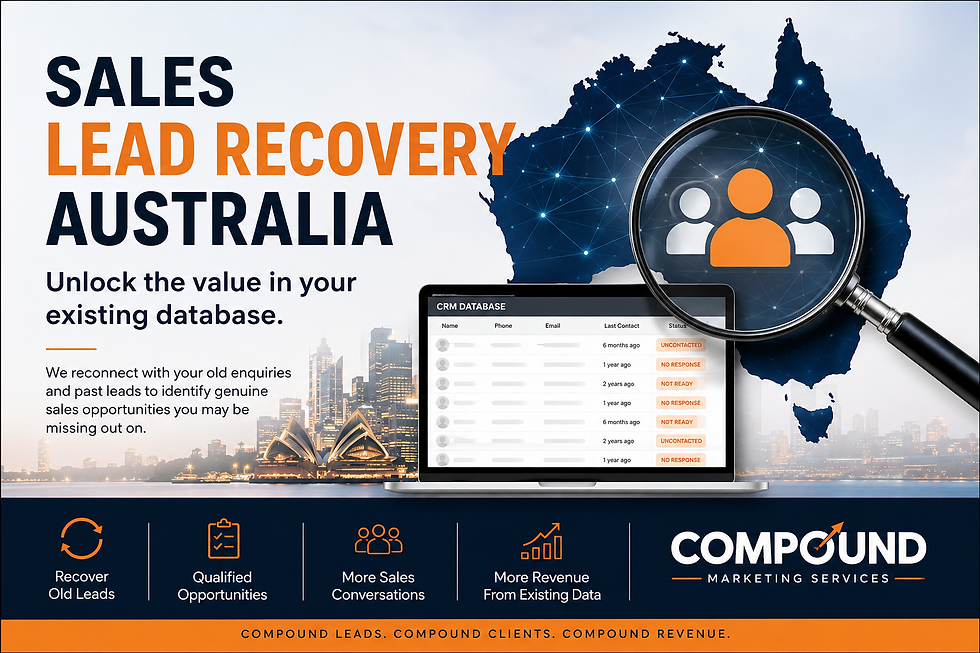
Can Sales Lead Recovery Be Conducted Australia Wide? Yes, it can. With the right process, lead recovery campaigns can be run remotely across every Australian state and territory, using phone, SMS and email to re-engage old, dormant and unconverted leads.
For Compound Marketing Services, the goal is simple: help businesses recover value from enquiries they have already paid to generate.

What sales lead recovery means
Sales lead recovery is the process of reconnecting with people who previously showed interest but did not convert.
These leads might include:
Website enquiries that never booked
Quote requests that were not accepted
Phone enquiries that stopped responding
Trial or consultation bookings that did not proceed
Old database contacts who have gone quiet
Past customers who may be ready to buy again
Leads from previous campaigns that were not worked properly
A recovered lead is not always someone who buys on the spot. Sometimes the first win is a reply, an updated need, a better phone number, a fresh appointment, or a clear “not interested” that cleans up the database.
That clarity has value. A business can stop wasting time on poor-fit contacts and pay more attention to people who still want help.
For multi-location businesses, lead recovery also creates a national view of what is sitting in the pipeline. Instead of each site guessing, the business can see which regions, services and lead types still hold opportunity.
Why Can Sales Lead Recovery Be Done Australia Wide
Lead recovery does not require face-to-face contact. It needs accurate data, a clear message, disciplined follow-up and a team that knows how to speak with potential customers.
That makes it well suited to a remote, Australia wide model.
A well-run campaign can contact leads in:
New South Wales
Victoria
Queensland
Western Australia
South Australia
Tasmania
Australian Capital Territory
Northern Territory
The campaign can be adjusted for time zones, trading hours, local service areas and branch availability. A customer in Hobart should not receive the same appointment offer as someone in Darwin if the local team has different booking times. A lead in regional Queensland may need a different service path from a lead in inner Sydney.
The work can still be managed centrally. Calls, SMS messages and emails can be tracked from one system, while outcomes are sent back to the correct location.
This is especially useful for businesses with:
Franchise networks
National sales teams
Dealership groups
Health, fitness or wellness locations
Trade and home service branches
Education and training providers
Property, finance or professional service networks
Retailers with stores in several states
The customer does not need to know the campaign is being run remotely. What matters is that the contact feels timely, relevant and connected to their local branch or service area.
Phone, SMS and email each play a different role
A strong lead recovery campaign does not rely on one channel. People respond in different ways, and old leads often need more than one touchpoint before they take action.
Phone calls create human contact
Phone is still one of the most useful channels for old or high-value leads. A call allows the recovery team to ask questions, listen, handle objections and qualify the lead properly.
A good recovery call is not a hard sell. It might sound more like:
“We’re following up on an enquiry you made a little while ago about [service]. Just checking whether you still needed help with that, or if your situation has changed.”
This works because it gives the person room to talk. Some leads will say they already bought elsewhere. Some will say they are still interested. Others will explain what stopped them from moving forward.
That feedback can help the business improve its sales process.
SMS messages make follow-up easy
SMS is helpful when a person does not answer the phone or needs a quick prompt. It is short, direct and easy to reply to.
For example, an SMS might say:
“Hi Sam, it’s Compound Marketing Services calling on behalf of [Business]. You enquired about [service] a while back. Are you still interested in getting help with this? Reply YES and we’ll arrange a call.”
SMS can also confirm appointments, send callback options, or give the lead a simple way to opt out.
The key is to keep it clear and respectful. No spammy wording. No pressure. No vague promises.
Email gives context and detail
Email is useful when a lead needs more information before responding. It can explain why the business is getting back in touch, what has changed, and what the next step is.
Email also works well when the original enquiry involved a larger purchase, a considered decision, or a service that needs explanation.
A recovery email can include:
A reminder of the original enquiry
A short update about the service
A clear next step
A contact option
A simple opt-out line
When phone, SMS and email work together, the campaign feels more complete. A call might start the conversation, SMS might get the reply, and email might support the decision.

The remote process behind an Australia wide campaign
Running lead recovery across Australia is not just a matter of calling a list. The campaign needs structure. Without it, teams risk duplicate contact, messy handovers and poor customer experience.
Compound Marketing Services can support a national campaign by building a clear process around the database, the script, the contact sequence and the reporting.
1. Clean and prepare the lead data
The first step is to gather the available leads and sort them into useful groups.
That may include sorting by:
State or territory
Nearest branch or location
Original enquiry date
Service or product interest
Lead source
Contact status
Previous sales notes
Consent and communication preferences
Old databases are rarely perfect. Some phone numbers may be wrong. Some emails may bounce. Some records may be duplicates. Data cleaning helps reduce wasted effort before the campaign starts.
2. Build a contact plan
The contact plan sets out how many times a lead will be contacted, through which channels, and over what timeframe.
For example, a campaign may use:
One initial call
One follow-up SMS
One email with more detail
A second call attempt at a different time
A final SMS or email to close the loop
The plan should be firm enough to keep the campaign consistent, but flexible enough to suit different lead types. A high-value quote request may deserve more effort than a low-intent form fill from two years ago.
3. Use local routing for national enquiries
For multi-location businesses, every lead should end up in the right place.
A recovered lead from Adelaide may need to go to the South Australian sales team. A Perth lead may need a callback during Western Australian business hours. A customer in Canberra may need a location-specific appointment option.
Remote lead recovery works best when the central team handles the re-engagement, then passes warm leads to the right branch with clear notes.
Those notes should include:
What the customer wants
Their preferred contact method
Any timing issues
Objections or questions raised
The agreed next step
That way, the local team does not start from scratch.
4. Track outcomes properly
Good reporting shows more than how many calls were made.
It should show:
Leads contacted
Leads reached
Positive replies
Bookings or callbacks created
Unsuitable leads
Wrong numbers or bounced emails
Opt-outs
Common reasons leads did not convert earlier
This information can reveal patterns. If several leads say they never received the original quote, the issue may be follow-up speed. If many people say the offer was unclear, the sales message may need work. If one location has far more dormant leads than others, it may need extra support.

Why multi-location businesses benefit most
A single-location business can often manage old leads manually. A multi-location business has a bigger challenge. More locations usually means more lead sources, more salespeople, more customer journeys and more chances for enquiries to fall through the cracks.
Lead recovery gives multi-location businesses a way to regain control.
It creates consistency across locations
When every branch follows its own follow-up process, results vary. One location may call leads quickly, while another waits days. One team may document outcomes, while another keeps notes outside the system.
A national recovery campaign gives the business a consistent standard. Each lead receives a planned contact sequence. Each location receives similar handover notes. Each manager can see what happened.
It helps uncover hidden revenue
Dormant leads are often already paid for through advertising, referrals, events, partnerships or website traffic. Letting them sit untouched means the business is leaving value in the database.
Recovering even a small portion of old enquiries can reduce pressure on new lead generation. It can also help during quieter periods, when sales teams need more conversations but do not want to increase ad spend straight away.
No campaign can promise that every old lead will convert. A well-managed recovery campaign can still find people who are ready, interested or worth nurturing.
It improves customer experience
Customers notice when a business follows up well. A polite call or message can turn a forgotten enquiry into a positive interaction.
Even if the person no longer needs the service, respectful contact leaves a better impression than silence. For national brands, that matters. Every location contributes to the wider reputation of the business.
It gives leaders better data
Lead recovery also acts like a diagnostic tool.
It can show:
Which locations are sitting on the most old leads
Which lead sources produced poor-fit enquiries
Which services attract delayed buyers
Which objections appear often
Which follow-up gaps need fixing
This helps senior teams make better decisions about sales training, marketing spend, CRM setup and branch support.
Compliance and customer trust matter
Australia wide lead recovery must be handled carefully. Businesses need to respect privacy, consent and customer preferences.
Campaigns should consider relevant Australian requirements, including the Privacy Act, the Spam Act and the Do Not Call Register. The exact obligations can vary depending on the type of business, how the lead was collected and what consent was given.
A responsible campaign should:
Use accurate sender details
Avoid misleading claims
Honour opt-out requests
Keep messages relevant to the original enquiry
Avoid excessive contact attempts
Protect customer data
Record contact outcomes clearly
This is not just about avoiding complaints. It is about keeping trust. Old leads may not remember every detail of their enquiry, so the contact should be clear, respectful and easy to understand.
What a strong lead recovery campaign needs before launch
A campaign will perform better when the business prepares the basics first.
Before launch, gather:
A clean list of leads
Branch or territory rules
Service availability by location
Current offers or booking options
Approved call scripts and message templates
Clear rules for warm lead handover
Access to booking links or callback processes
A list of leads who should not be contacted
The business should also define what success looks like. For one company, success may be booked appointments. For another, it may be updated records, reactivated customers or better visibility across the pipeline.
The clearer the goal, the easier it is to report on value.

Why choose Compound Marketing Services for Australia wide lead recovery
Compound Marketing Services helps businesses turn old, dormant and unconverted enquiries into fresh sales opportunities. For multi-location businesses, that means building a repeatable campaign that can operate across Australia without needing separate teams in every state.
The service can support:
Remote calling across Australian time zones
SMS and email follow-up
Lead list cleaning and segmentation
Location-based routing
Warm lead handover
Clear campaign reporting
Feedback on why leads did not convert the first time
The real value is not just contacting people. It is creating a process that protects the customer experience, supports each location and gives the business useful sales data.
If your business has old enquiries sitting in a CRM, spreadsheet, inbox or booking system, those leads may still hold value. Some will be cold. Some will be out of date. Some will be ready now.
Compound Marketing Services can help you find the difference.
Turn old leads into new conversations
Sales lead recovery can be done Australia wide for multi-location businesses when the campaign is planned properly. Phone, SMS and email make it possible to re-engage leads remotely across every state and territory, while still routing genuine opportunities back to the right local team.
Old leads should not sit untouched while the business pays for new enquiries. A structured recovery campaign can clean up the database, restart customer conversations and reveal sales opportunities that were already there.

Comments